Showing posts with label media. Show all posts

Friday, April 4

If you're brave enough to give a little, you get a little back

It's important to consider the privacy of others - particularly children - when posting photos to the interweb.


Early in the history of Flickr I got a little freaked out when a friend's photos of her kid were snagged by an unknown woman who built a scary blog using the photos and her own stories to make like the kids were hers and not my friend's. Scary stalker stuff.


A while later, a naked photo of my son on Flickr received some unwelcome attention. Ick. But the sensible solution was not to post naked pictures of my kid - or anyone else's. Problem solved.


You'd think anyone managing a young sports star these days would either ban or closely moderate their entire participation in online social networking, but this week we saw controversial photos from members of the Australian Olympic swim team that had been snagged from their Facebook profile. Can't blame the journalists: need a photo to accompany a story, the choices are (a) pay $10,000 to a paparazzi and wait 24hrs to receive it, or (b) look up their Facebook profile and snag the photos they've added, free of charge? No brainer.


facebook swimmers.jpg


I could have over-reacted to the Flickr experience and never posted another photo of my son to the interweb, but then my gypsy family would never get to see their cousin/nephew/grandson at all. I could password-protected everything, but then family would never remember the password and never get around to asking me for it.


If I'd done either, I never would have seen this cool line art done by someone on Flickr, based on a photo I'd taken of my son:


iBoy on Flickr - Photo Sharing!.jpg


Which was based on this photo of him grooving on his iPod while we were camping last year:


DSC02168.JPG on Flickr - Photo Sharing!.jpg


On the interweb, I think it's worth giving a little in order to get something back, and this is a great example.


For that reason, I make my photos on Flickr available on a Creative Commons "attribution-non-commercial" licence, meaning you can use them for anything non-commercial as long as you attribute them to me with a link. I'd be stoked if anyone else created good art out of something I just opened a shutter on for a fraction of a second.


Wednesday, January 30

This is not about me.

A new post from Nic Hodges helped coalesce some of my recent thinking about social messaging and social networks. Nic talks about how two-way, conversational media is now becoming as involving and entertaining as, say, '60 Minutes'. And a lot more entertaining than 'Girls of the Playboy Mansion.' No, really.


Why is this so? How can smileys out-engage boobies?

The simple answer is that rediscovering that real people’s real lives can be entertaining, informative and engaging too.

But the complex-erer answer that I don't yet have any evidence beyond a strong gut feel is that documenting the events in your life - and how that changes you - is an activity that doesn’t only gain you an audience, it also helps you define and refine who you have been, are currently, and are becoming.

Defining who you were/are/will be is as compelling as it gets.


Girls of the Playboy Mansion: come on, seriously, you can't tell me this is entertainment...

Your identity isn’t just who you are now. It’s a vector, or a series of curves perhaps. It starts in the past, charting your passage through the events and ideas you’ve experienced and your reaction to those events and ideas.

That vector passes through the present, and that’s what we see of someone and usually think of identity. But the present is only the thinnest possible cross-section of your identity and in isolation gives only the slightest suggestion of who you will become as you continue on into the future.

I think social messaging and social networking is so fundamentally engaging because it gives us an opportunity to capture key moments of our identity as we move forward in time, leaving a documented history behind us, interwoven with the events, ideas, and people we’ve been introduced to along the way, and leaving evidence of how we’ve been influenced by them.

My prediction: browsing real people’s lives and documenting our own for others to browse will be the new entertainment hit for the 2020s. Partly because network television quality can sink no lower, partly because social messaging and social networking is just plain fun.

But mostly because, way down deep inside, we're learning about ourselves. 

And nobody's more interesting than me. Or you. Unless you happen to be me.

Tuesday, January 8

BBC's Inside Dot Com: so not inside!

Initially I was excited to hear that The Beeb was running a documentary series, Inside Dot Com, following the trials and tribs of a few early-stage interweb startups.

But judging by the clips on YouTube, it stinks. It could only seem "inside" to someone standing very far outside, or perhaps someone standing inside but experiencing it all for the first time, from a video-editor's visitor's chair, like a documentary producer who's previous body of work was on antique furniture or wildlife documentaries.

LOL: this crowd call in an "advertising agency" to tell them what consumers "think of the site's design". Like almost every time I've seen an ad agency give feedback on a website, the conclusions are all about the site's graphic design - it's brand feedback, not its user experience. A branding study is valid, but you should be conducting that before you buy a domain name and design a brand, and you should never, ever confuse a brand focus group study with a usability study.

Somehow, advertising agencies got away with pitching TVCs as storyboards and radio ads as scripts for so many years that they think it's OK to test websites basically the same way. It is so not.

Classic moment: the ad agency guy presenting the focus group results says, "and my son didn't even like it" as if that's the killer blow. Any time I hear "I/my kids/my wife didn't like it" I know it's time to stop paying attention and wind-up the meeting. That's a big, pulsating warning sign above your head that says, "I do not understand that this should be about something deeper than initial reactions to colours, shapes and styles. And I do not understand that this is about a target audience, of which I am not a member. Neither is my brat emo child, who hates me enough to veto all of my work."

Disagree? Your honour, I call Larry and Sergey as my first witnesses. They certainly didn't waste any time getting an ad agency to show a few A3 printouts of the Google homepage to 20 people prepared to spend an hour in a small room for $50 and a few sandwiches. Nobody in that room would have said, "Oooh, I like 'google' as a name. When I think of search I immediately think of the word 'google'." Nobody would have said, "I think showing each letter in a different colour is a great idea. And you can't have too much plain black text on a white webpage, if you ask me!"

This one isn't even an interweb startup - it's a shop with a website - not even remotely the same thing. If The Beeb can't appreciate the difference, I'm afraid watching the series may be a waste of time.

Final insult to our intelligence: the Beeb won't allow YouTube users to embed these videos on their own pages (or I would have posted them here instead of linking them.) They're not full eps, they're just highlights. Ack!

Another example of the old media not grokking the new. Did we need another?

Sunday, September 9

ZDNet tries harvesting an audience from Facebook


Facebook audience harvesting for publications
Originally uploaded by thatjonesboy.

The Facebook platform is an extraordinary venue for reaching out to a large online audience and encouraging them to try your own web application. As you'd expect, I've been observing the evolution of Facebook closely, not only as a chance to poke my friends, but to observe a rapid and significant evolution in the way we attract and retain an audience.


In the first wave of Facebook platform apps, solo developers built little fun apps primarily to show off their own coding skills, without much thought given to driving app use or polishing the many bugs. Soon, there were a hundred ways to do more than poke a friend, or rate someone as hot or not.

In wave two, when most obvious Facebook app categories were populated with a few competitors, the more ambitious developers began re-coding their apps to focus on acquisition and retention, to ensure they'd win and then retain number one position in their category. But they were still apps that, for the most part, existed only on Facebook. They didn't try to leverage the platform to build their own audience. And they weren't any more commercial than the typical widget; they certainly weren't selling ad space.

In wave three, other major web applications such as Flickr, Twitter and Last.fm launched Facebook-specific apps tying their service to Facebook's user database, allowing consumers using both platforms to stay engaged with, say, Twitter, while Facebook was their front-most application. This was smart because the Facebook platform doesn't threaten the ownership of user data - if you unhook from Facebook later, you can take your users with you. There are more benefits than risks in building and deploying a Facebook version of your web app.

An online media business gets another UB, some more pageviews, some additional ad impressions. All from the most unlikely of sources... a Facebook app.

Here's a new wave that I've only just discovered: an online media business (in this case, ZDnet.com.au) building a Facebook app to try and gain some viral growth in their online audience by giving Facebook users something fun and engaging to try.

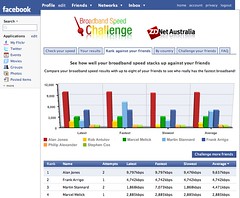
Initially, the Broadband Speed Challenge application does what many similar apps do - test your internet connection and give you a whizzo dashboard of animated dials to display just how fast your up- and downloads are.

This must have demanded some outside-the-square thinking at ZDnet - a media business used to writing up news and then selling ads on it - checking people's connection speed is not a core competency. But it's clever, it's useful, and it has relevancy, as you'll see in a minute.

BSC then goes further by allowing you to compare your net connection speed with your friends on Facebook, and invite your other Facebook friends to try the test for themselves. It's cool because it's something no other speed test application could do for you, since most speed test apps have a regular monthly audience of zip/zero/nada.

I was ever-so-slightly-stoked to learn that I had the fastest connection amongst the six friends who'd tried it so far. In yo face, suckas ;-)
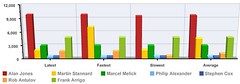
i 8wn u suckas!

Then the app goes one smart step further and shows you some wifi/broadband feed headlines from ZDNet. Now, I haven't been a fan of ZDnet. I was a regular reader 3-4 years ago, but then I felt it headed downhill, and I haven't read it since. Until tonight, that is. I've learned the writing's improved, the research is better, the writers are more experienced, so I've resubscribed.

Would I change anything? Yes, I'd probably test the ubiquitous "invite all your friends to try this app" approach that most Facebook developers try. Yes, it's annoying, but it becomes less-so when every dang app you install tries it on. Note I said "test it", I didn't say "adopt it" - see how much it annoys your own subset of the Facebook audience first. I'd also test increasing the prominence of the ZDNet feeds, and see if that affected adoption, usage, or clickthrus to ZDnet.

In ye olde dayes, online social networks and web apps would shrivel and die without the help of online media businesses to build a brand and acquire an audience. Is this example a sign that maybe the relationship, in some cases, is being turned on its head?

An online media business gets another UB, some more pageviews, some additional ad impressions. All from the most unlikely of sources... a Facebook app. Well, I live and learn.

Friday, June 15

Clearspring: the publishing network for widgets

The business of building, distributing and tracking widgets suddenly got a whole lot easier, thanks to Clearspring.


...or at least, it would, if I had a proper widget instead of this RSS feed, which looks all wrong for me because Firefox autosenses it and wants to add it straight to Google Reader for me. Grrr...

But Clearspring shows tremendous promise because it doesn't just help you build a widget and promote it in a widget gallery, it helps you track the people who take your widget and put it on their web pages. This network thinking is very smart.

Hey, I was able to get this one working, sort of, from Springwidget via Feedburner.


But Springwise doesn't include any tracking :-(

Buy content through ScooptWords
