Update: I stand corrected, and so should Pete Yandell, my original source for this story. Thanks to the diligence of readers like you, I've now learned everything I missed while I ducked out to put the kettle on while the iPhone SDK videoconference was playing: there absolutely is a way for a small business to test an iPhone app without offering it over iTunes Store, and developers who only want to release products to their own staff are able to pay a little more for the ability to do that privately via iTunes Store.
However, it still seems a strategic mistake to open the SDK to US developers only initially. Software development quality does not respect geographical boundaries, and the largest and most experienced mobile software development communities are all outside the US.
Anyway, read on, see where I was wrong, and please join in the very healthy discussion in the comments for this post!
It's been a couple of weeks since the launch of Apple's iPhone Software Development Kit (SDK) and it's taken me that long to find a serious flaw worth noting in what has been an otherwise enthusiastically-received program.
Wednesday, March 19
Updated: OK, no flaws in Apple's iPhone SDK after all!

Tuesday, March 11
I Watch This - TV Guide recommendations on IceTV

I Watch This - TV Guide recommendations on IceTV
Originally uploaded by thatjonesboy.
Regular viewers will know I have a major jones for Electronic Program Guides (EPGs) and digital television. Early Aussie pioneer IceTV is still hanging in there despite being dragged backwards through the hedge of the courts by the unlimited resources of the interests backing Channel Nine.
Now IceTV have finally launched their recommendation feature, iwatchthis.com.au (hmm... shouldn't that be "Youshouldwatchthis.com.au"?). Whatever it's called, it gets you to tell it which shows are your favourites (or you can let it watch what you record) and it'll come back with recommendations.
How well does it work? Well, my experience is limited because although I still have a login, my paid subscription to IceTV lapsed and I haven't renewed. Unluckily for IceTV, recently I fell in love with AppleTV and buying shows from the US iTunes Store and haven't had much time for Australian free-to-air television since then.
But my login allowed me to 'favourite' a few good shows in IceTV, including Foreign Correspondent, Lateline, Media Watch and Cutting Edge, just to test out the recommendations ('cos regular readers will recall, I also have a major jones for all things recommendations).
I expected IceTV's recommendations to be fairly good: highly engaged customers providing relatively accurate data, genre and cast relationships providing clear pointers to recommendable content, and most of all in Australia, a relative paucity of content to choose from!
So sure enough, IceTV scored a nice 5 out of 10 in terms of other shows I'd like to watch. But is that really helping me much? I mean, there's so little on free-to-air in Australia I don't really need recommendations at all, much less recommendations that are as likely to be wrong as right.
To really make the payoff, IceTV should be there to let me know when a new series of Top Gear is starting, because it knows I enjoyed the last series. It shouldn't be distracted by a repeat of a previous series, or the same series being screened a second time in a different time slot. Does it do this? Dunno, not possible to tell from my exploration.
Perhaps if IceTV offered me streaming previews, independent reviews rather than synopses, or even production stills. But the local commercial networks aren't about to help - they still see IceTV as stripping away revenue with ad-skipping features, when really they should see IceTV as one of the few things that can help them win and retain what remains of a viable media audience. Sigh.
This morning in da house: Yorke Hinds

Peepl have been dropping around to our house a bit lately, mostly to sample our fantastic fresh-ground Forsyths coffee (ZOMG it's so good I'm gonna make another now) but also to chat a bit about new opportunities on da interwebs. With no consent or prior warning, I'm going to use my iPhone's craptastic fuzzycam and Twitxr.com's social photomessaging to record some of these visits for posterior-ity. Sorry Yorke!
Yorke's next large-ish thing will be a platform that helps interweb startups manage relationships with the greatest double-edged sword of web development: the beta tester. I'm waiting for my alpha invite from Yorke, really looking forward to having a muck about with it. Unfortunately my feedback will need to remain confidential for the time-being, but hopefully I can tell you all about it very soon when it enters a more open beta.
Thursday, February 28
Amazon's international billing problem
Met Mike Culver, web services evangelist for Amazon's S3 cloud services today on his first trip downunder. All this cool stuff about how we can base an entire startup on a pay-as-you-go storage and computing model with the same reliability and speed as Amazon itself.
Mainly technical discussion, so a lot of it way over my head but one of my questions hit home:
If Amazon's charging me in USD and only accepts credit card payment, the foreign currency exchange fee my bank is going to charge me is a big hit. My bank's 3.3% for Mastercard and 3.4% for Visa foreign currency transactions is probably standardish.
Mike hadn't come across that before but seemed serious about taking that issue back to the US to get solved.
Not as big an issue for me personally as having no amazon.com.au, but prolly enough to make such a variable cost unaffordable here.
US companies still aren't great at the whole international product strategy.
(btw, no links or image with this post because iPhone STILL doesn't support copy & paste grrr)
[Sent from my iPhone, still unable to copy and paste and it's 2008]
Tuesday, February 26
Death of social networks? Not that way, and not yet!
 Mark Jones of Filtered Media is predicting the death of social networking. I don't think death is coming any time soon, and certainly not from Google and Gmail as Mark suggests. I think the bigger future threat for MySpace and Facebook are microblogging and social messaging layers over the top of the social networks.
Yes, social networks can't sustain the current growth. There will be a plateau. Following the plateau will come more realistic valuations, rationalisation and acquisition by the networks.
Yes, to some extent social networks will atomise - social networking platforms are already starting to blend in the features of other web platforms via their APIs and developer platforms, and it makes sense that some of that platform functionality will bleed out into email, search, blogging and other web platforms over time.
The 'friend spam' we see now on Facebook is a function of the immaturity of the social network businesses themselves, which are still learning how to manage open platforms, and to some extent a learning process for users - it's already unfashionable to be the friend who sends too much social network spam - soon, it will be social suicide.
I can't see Mark's 'Email 3.0' spelling the end of social networks. If I were an 18-25 year old, why would I need to wrangle with Hotmail and Yahoo! Mail if I can use Facebook's email to stay in touch with everyone I know? Hotmail spam vs Facebook spam? Give me the latter any day.
Why would I need to search from the Google homepage if Facebook was my homepage and I could launch a Google search from a Facebook app in my profile page?
Google's become the default for us 30-40 year olds, and Yahoo! is the default for our parents, but Facebook and MySpace have an opportunity to be the default starting point for our kids. ...if they seize the opportunity and execute well, which so far they have had trouble with.
Email is inherently a functional product - I need to have something to communicate to someone before I send an email. However social networks work best when I can use them as inspiration for finding something to say to my friends. I may not have any news myself today, but by browsing what my friends have been up to recently, there's always something that I can comment on, criticise, debate or LOL at.
Social networks will remain a place that people go to 'hang out' with their friends and meet new friends online. There will be fewer of them in the future, and the big ones will probably be owned by larger networks as MySpace is now.
But just as social networks have an opportunity to steal the email, search, media sharing and buying/searching eyeballs from the incumbents, there is already a couple of threats to the social networks: social messaging businesses like bluepulse (who are more comfortable if I disclose that I'm contracting for them any time I mention their name online, bless 'em!) and microblogging services like Twitter.
Social messaging businesses threaten social networks because they may steal away the user's all-important 'status message'. Without the status message being updated there's half the value of the Facebook newsfeed gone, and the newsfeed is everything to Facebook's business. If I can more quickly and easily update what I'm doing now from my mobile phone on bluepulse than I can on Facebook, then sure, Facebook may lose me (that's "me the hypothetical 20 year old" not "me the 43 year old".) Facebook's mobile product is still lame: you can't sign up as a Facebook user from a phone, and many of the key features are missing from the mobile product. Using MySpace's mobile product is like travelling back in time to 2000 and back in space to Boondocks, Carolina. I don't see any sign that Facebook or MySpace 'get' the importance of building a better mobile product yet.
Microblogging services like Twitter can also steal away the status message traffic and user loyalty from the social networks, by making it all about status messages, and then using the social network's own APIs to let the user update multiple social networks from one spot, saving time and money, both very precious to 18-25 year olds.
Saturday, February 2
Say goodbye to the value of your social graph
Google's released a new API that allows developers to harvest the 'social graph' - the relationships between people on the web - the links labelled 'friend', 'colleague', 'mother', between our individual online identities.
At the moment, there is no single social graph for the interweb. Instead, separate proprietary graphs exist on each of the major portals (Yahoo!, etc) and also on the major social networks (MySpace, Facebook, Bebo, LinkedIn, etc.). To a large extent, the value of these companies is tied up with the size of users graphed, the number of connections in those graphs, and the rate of growth in users and connections.
Because of the risks vs benefits involved, it seems unlikely that Google will be able to persuade players with high-value social graphs to open their data to the API very soon. Any player with a high-value social network risks contributing more value to its competitors than it receives by opening to the API. Google might be able to gain enough leverage to bring a majority in eventually.
If the industry adopts an open API for social graphing then it must also offer better tools to allow users to explicitly control what relationships are exposed, to whom, and to what level of detail. While the social graphs remain closed and proprietary the cost of unplanned exposure is still pretty low (though I continue to have a problem with the way LinkedIn exposes which other profiles have been viewed by the people who've been looking at my profile.) But if we move towards one shared social graph, it's going to be essential that you own and control it.
MSFT & YHOO: can the snake swallow the elephant?
Microsoft swallowing Yahoo! is either going to be fast and ugly, or slow and ineffective.
Good friend Goonker said it best. Referring to Steve Ballmer's quote that he feels "putting these things (Microsoft and Yahoo!) together with a great integration should be quite an accelerant to progress." Goonker says, "accelerant as in: flame out quickly?"
Friday, November 9
The wrong way up a one way street of content

There are now so many microblogging platforms out there, and they're all so new none has quite achieved ubiquity yet. So teh kiddies at hellotxt have decided the right thing to do is to add anothr layer of aggregation on the interweb, this time to let you update all your microblog feeds from the one microblogger.


Why do I want to flip the model?
Wednesday, September 12
Ringles don't make me tingle
ARIA's latest figures show a 47% decline in CD single sales year-on-year.
The only really shocking thing: that so many Australian consumers are still paying through the nose for the physical music product when the identical track is available online for about a third of the price.
Anyway, there's nothing to wring your hands about (unless you own a CD pressing business) because sales of online digital single tracks increased by 64% in the same period, and at $8.38m in sales revenue is a little more than twice the value of physical single sales. Plenty healthy. Factor in the higher margins at almost every step in online versus physical production, distribution and delivery, and it's a healthy business to be in, as long as you're big enough to have a roster of successful artists and at the same time small enough to be able to keep up with the pace and true direction of change.
By "true direction" I mean where the industry is actually going, versus where some believe it can be steered. The former is entirely in the hands of the consumer, influenced by the content offerings available to them, how that content is priced and to what device it is delivered. The latter almost entirely the exclusive domain of large music labels and the industry bodies that serve them.
Evidence of a failure to keep up with the true direction of change: talk of prolonging the life of CD singles by including "ringles" - ringtone versions of the single - on the CD, along with software that will make it "easy" to transfer the ringtone version of the track to a mobile phone.

Please, don't let's pretend for a moment that this might have the slightest chance of widespread consumer adoption! Consider the "Sony rootkit" fiascos, and what might need to be installed on the consumer's PC in order to deliver a ringle from CD drive to handset. Better find a way to provide technical support for Windows '98, 2000, XP, Vista, OS X and Linux installation issues for product that retails for $5. Don't even start about what tiny percentage of mobile consumers ever successfully connect their handset to their PC, or want to do so for any reason.
Is it even possible to deliver a software application within the constraints of CD single data storage limits that might have a chance of being compatible with the diverse community of mobile handset operating systems, ringtone file types and carrier locks out there in the marketplace? I don't like the word "impossible" - it always seems to get me in trouble - but let's just say I'd be flabbergasted.
The only sensible way to deliver ringtones to mobile handsets is online, and for the majority of mobile consumers, the carrier - not the label, not the handset manufacturer - owns that pipe. No CD single "ringle" is going to influence that in the slightest. Labels: work with the carriers... or maybe acquire them. Carriers are to the future of music what radio broadcasters have been in the past, plus the entire retail supply chain. Getting out of that headlock they have on you is going to take more than a "ringle" or two.
Sunday, September 9
ZDNet tries harvesting an audience from Facebook
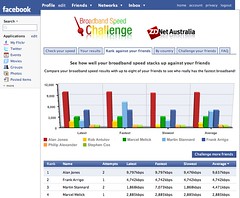
Facebook audience harvesting for publications
Originally uploaded by thatjonesboy.
The Facebook platform is an extraordinary venue for reaching out to a large online audience and encouraging them to try your own web application. As you'd expect, I've been observing the evolution of Facebook closely, not only as a chance to poke my friends, but to observe a rapid and significant evolution in the way we attract and retain an audience.
In the first wave of Facebook platform apps, solo developers built little fun apps primarily to show off their own coding skills, without much thought given to driving app use or polishing the many bugs. Soon, there were a hundred ways to do more than poke a friend, or rate someone as hot or not.
In wave two, when most obvious Facebook app categories were populated with a few competitors, the more ambitious developers began re-coding their apps to focus on acquisition and retention, to ensure they'd win and then retain number one position in their category. But they were still apps that, for the most part, existed only on Facebook. They didn't try to leverage the platform to build their own audience. And they weren't any more commercial than the typical widget; they certainly weren't selling ad space.
In wave three, other major web applications such as Flickr, Twitter and Last.fm launched Facebook-specific apps tying their service to Facebook's user database, allowing consumers using both platforms to stay engaged with, say, Twitter, while Facebook was their front-most application. This was smart because the Facebook platform doesn't threaten the ownership of user data - if you unhook from Facebook later, you can take your users with you. There are more benefits than risks in building and deploying a Facebook version of your web app.
An online media business gets another UB, some more pageviews, some additional ad impressions. All from the most unlikely of sources... a Facebook app.
Here's a new wave that I've only just discovered: an online media business (in this case, ZDnet.com.au) building a Facebook app to try and gain some viral growth in their online audience by giving Facebook users something fun and engaging to try.
Initially, the Broadband Speed Challenge application does what many similar apps do - test your internet connection and give you a whizzo dashboard of animated dials to display just how fast your up- and downloads are.
This must have demanded some outside-the-square thinking at ZDnet - a media business used to writing up news and then selling ads on it - checking people's connection speed is not a core competency. But it's clever, it's useful, and it has relevancy, as you'll see in a minute.
BSC then goes further by allowing you to compare your net connection speed with your friends on Facebook, and invite your other Facebook friends to try the test for themselves. It's cool because it's something no other speed test application could do for you, since most speed test apps have a regular monthly audience of zip/zero/nada.
I was ever-so-slightly-stoked to learn that I had the fastest connection amongst the six friends who'd tried it so far. In yo face, suckas ;-)

i 8wn u suckas!
Then the app goes one smart step further and shows you some wifi/broadband feed headlines from ZDNet. Now, I haven't been a fan of ZDnet. I was a regular reader 3-4 years ago, but then I felt it headed downhill, and I haven't read it since. Until tonight, that is. I've learned the writing's improved, the research is better, the writers are more experienced, so I've resubscribed.
Would I change anything? Yes, I'd probably test the ubiquitous "invite all your friends to try this app" approach that most Facebook developers try. Yes, it's annoying, but it becomes less-so when every dang app you install tries it on. Note I said "test it", I didn't say "adopt it" - see how much it annoys your own subset of the Facebook audience first. I'd also test increasing the prominence of the ZDNet feeds, and see if that affected adoption, usage, or clickthrus to ZDnet.
In ye olde dayes, online social networks and web apps would shrivel and die without the help of online media businesses to build a brand and acquire an audience. Is this example a sign that maybe the relationship, in some cases, is being turned on its head?
An online media business gets another UB, some more pageviews, some additional ad impressions. All from the most unlikely of sources... a Facebook app. Well, I live and learn.
Thursday, August 9
Yahoo! still stays still for the camera

This is the earliest digital photo I have on online storage. Uploaded 10 December 2000, it's from a holiday to the NSW ski fields, looking down on some ducks that were skating around on the frozen lake in front of our hotel.
Anyway, for the last seven years it's been hosted with Yahoo! Photos, where it did almost nothing except take up 200k of disk space. Nobody much came and viewed it, nobody emailed it to a friend, nobody happened across it while browsing popular tags, nobody made a new friend as a result of viewing it, and crucially, nobody ever printed it out on a mug or a mousemat.
Not because it was a bad photo necessarily (though it might be) but because Yahoo! just failed to grok the social networking 2.0 wave that it helped touch off by launching web 1.0 market leaders like Yahoo! Messageboards, Yahoo! Groups and Yahoo! Bookmarks. Rather than grok it, Yahoo! was swamped by the wake of social networking 2.0 as it powered on past, floundering in the backwash of early precursors like eBay and Geocities, then by Flickr, MySpace and Facebook.
What is MySpace but Geocities with easier page editing and friend-finding? What is Facebook but Yahoo! Groups with an open API and some ajax? And what is Flickr but Yahoo! Photos plus social networking?
So in a few weeks my little duckies will be migrated across to live with my other photos on Flickr, where for the first time they will get pageviews, comments, favourites and other forms of sticky social interaction. All my little duckies will be in a row. Yahoo! had to pay reportedly USD35M for this to happen, when it probably had 4-5 years of breathing space to see this coming and just build it themselves.
Flickr was acquired in 2005, and since then, have we seen further significant innovations from the Flickr team? No, not really. It's taken them nigh-on two years to wait for management to summon up the courage to jam the two services together, fer chrissakes!
Should they add video uploading and sharing as a matter of urgency? You know they should. Will someone eat their lunch if they don't? Of course they will. Do they already know that, and are they constrained from doing it due to organisational lethargy and lack of dev resources?
Well, it wouldn't be the first time...
Wednesday, May 23
How to be simple, and why

I was invited to present some findings to the management team of a business this morning, and gave the group one memorable story to take away.
A process they'd been pinning the business on since 2002 had grown so weedy with neglect that it now takes 47 steps to complete. But wait...
In the course of those steps there are four points at which, if you skip a step or make a mistake, your work is lost and you must start again.
During the process you need to have five programs open, plus at least two instances of Internet Explorer (one browser-based tool won't work properly with Firefox) You also need to use at least one of four Word macros.
During the process, you use a browser interface that includes features nobody knows how to use, features that aren't enabled, and other features that don't work.
There is even an error message that pops up towards the end of the process which is incorrect, and can be safely ignored... as long as you don't get into the habit of ignoring any other error messages.
There are two people who spend much of their working day repeating this process, up to ten times each, per day. Imagine what it must be like to be one of those people!
The Laws Of Simplicity is an awesome book in these situations.
(Tip of that hat to Scott)
Wednesday, March 28
I may be Apple Australia's most expensive customer
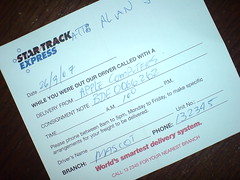
I may be Apple Australia's most expensive customer
Originally uploaded by thatjonesboy.
Since they insist on delivering products you buy from the Apple Store via courier only, and insist on that courier delivering it to you in person and getting your signature, and since the courier company can't be more specific about when they're going to arrive than "Wednesday" and is unable to ring you when they're on the way.
Courier company tells me that Apple pays them for another delivery charge every time they try to re-deliver it, and so far this is the fourth time they've tried to deliver my new AppleTV when I'm not home.
By my rough calculations, if this happened another 4-5 times, the cost of the delivery would be up around Apple's cost price on the AppleTV.
All that needs to change is for Apple Australia to offer additional delivery options; (1) no signature required; (2) no presence required; (3) pickup from nearest Australia Post branch. Offer these with the option of delivery insurance, and you've got yourself a convenient service.
Instead, what you've got is a time-wasting, costly and inconvenient service for me, for the courier company, and for Apple.
If your app were a person, what kind of person would it be?
Kathy Sierra is a technologist, a great writer, and looks good in a conference tee-shirt, no matter how baggy the schwag. She also has a great knack for analogies, like this blog post, where she asks, if your app was an employee, what kind of employee would it be?

It's clear to me from this description that Microsoft products are usually 'Anal-Retentive Guy', and getting more and more anal-retentive with each release, because Microsoft seems to think that's what we want when we ask for more security and stability in our operating system.
Like all good analogies, this is a simple exercise with really deep implications. BY all means ask yourself the 'which stereotype would it be?' question, but to get a more interesting answer, ask your employees and your customers. Each will be experiencing a different perspective of your product according to how they use it, support it, sell it and develop it.
Unfortunately all Kathy's stereotypes are negative, there's no match for products I love, like Comic Life. (Hmm... how about the guy you work with who always manages to take a menial, boring task and make it hilarious fun for you and the team?... we all know someone like that, right? ;-) OK, maybe positive stereotypes are a little hard!
Creating Passionate Users: Is your app an ass-kisser?
3's X-Series: I'm underwhelmed...
I know that one day, the competitive forces of economics will make one network operator break from the pack and decide to offer an open, all-you-can-eat, internet and voice plan. They'll decide it's better to lose the margins on distinguishing between data and voice than to lose the customer. "OK!" They'll cry. "Choose whatever browser and apps you want on your phone, just like you do on your computer. Just download and upload your data through our pipes!"
When I read that 3 had launched its X-Series offering here in Australia, I thought maybe that day had arrived. But no, I must wait a little longer. Instead, 3's X-Series is more of the same mobile superhighway robbery, only this time they're claiming it's 'just like an ISP plan'. Don't be fooled; it's nothing of the sort.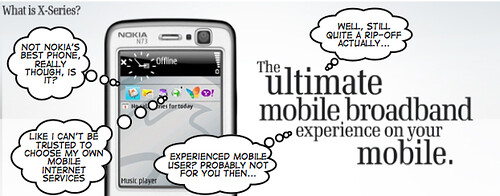 Fairfax quotes 3 boss Nigel Dews on this: "It is very similar to broadband pricing consumers know at home today, but in many cases will be much better value." Bollocks. The Australian X-Series offering would be "like an ISP plan" if your ISP restricted you to one of only four PC models, made its most generous plan $20 per Gb of data, limited the internet sites and software you could use, and then limited your use of that software, capping it to a certain number of minutes per month.
Initially excited to see Skype was one of the apps bundled with the handset, my enthusiasm faded when it became clear that only Skype-to-Skype calls are supported. No Skype-to-PSTN calls. Worse, even your use of Skype-to-Skype is capped, starting at 1,000 minutes per month on the cheapest plan and then 5c a minute thereafter.
Because X-Series plans are in addition to your voice minutes plan, you could quite easily find yourself paying a 5c a minute premium on your usual voice call rate to talk to Skype with someone on their PC using a device designed to place calls more easily and more quickly to their telephone! How attractive is that?
Your use of the other bundled apps and web services (Orb, a file-sharing app, Google search, Yahoo! Messenger, MSN Messenger and eBay) is also capped, with a 10c per Mb charge over your cap. Yes, that's cheaper than other Australian mobile networks. But are the kind of users savvy enough to want a mobile internet plan going to want a walled-garden of apps and web services? Do they need on-deck links to eBay and Google, or will they find that just a tad patronising? Most I know have these services bookmarked in Opera Mobile.
There is an uninspiring range of only four handsets available, omitting SonyEricsson, and surprisingly, not one of the phones supports all of the features and apps offered in X-Series plans. It's a question of 'which features can I live without?' when you come to choose your handset rather than 'which phone do I most like?'
Finally, the X-Series offering in Australia is considerably worse value than X-Series in other markets. Perhaps 3's reliance on Telstra to deliver some of the network is to blame, but X-Series is less expensive in Asia and the UK, and their plans are uncapped.
Friday, March 9
Payonce.com.au unfortunately... won't

Our latest household water bill (less than a third of the Sydney average, w00t!) included a promo for www.payonce.com.au - a service for time-poor, tech-rich groovers with lots of big monthly bills like me. Do I like paying bills? No, not even if I can do it all online. I want to do it faster, cheaper... ideally, have someone else do it for me.
Payonce.com.au's promise is to get as close as possible, by aggregating all your bills and allowing you to pay them via one service. Even better, it allows you to pay all your bills in one payment each month, just pay the minimum due, or spread regular payments out across the month.
I was very excited; until I tried to sign up and it all went very pear-shaped. The promotion in my water bill told me Payonce was ready to solve my bill problems. Unfortunately, it has too many problems of its own to be able to solve any of mine.
Minor credibility gap
I'm the sort of trusting early-adopter who'll sign up for nearly any service online, even if it means disclosing all my banking, billing and credit card details. But I'm odd: the typical consumer needs more than a little reassurance about who they're about to deal with.
When I clicked on Payonce's 'About us' link I expected to get some concrete detail about the company's executive team, investors and strategic alliances. The best example I've seen of this is the extraordinary detailed company information Wesabe reveals, including names, resumes photos and blogs of the company's founders, all its investors and alliances. Why, they even set aside a couple of hours each day in which the CEO will answer your questions on a toll-free number (not sure whether that scales to millions of customers, but heck, what a great start).
To my great surprise, Payonce thinks you'll be satisfied with the following cottonball fluff:
The dedicated team here at Acreis have got heaps of experience in banking, billing, finance, customer relations and IT, both in Australia and around the world. We've got the resources and know-how to bring you top class products and services!I feel so much warmer and fuzzier than before. But who ARE the dedicated team? What exactly is the length and breadth of their various experiences? Are they safeguarding my banking details with their combined personal credit card limits, or with the financial guarantee of a bank or insurance company? I'm all in favour of friendly, informal 'voice' in a web startup's branding, but when you're dealing with my financial information, I'd like to see some hard facts too.
I wasn't reassured when I found there was no street address listed for the company, only a post office box in Tasmania (the outsourced telemarketing team capital of the southern hemisphere, like Mumbai, minus all the head wobbling.) There is also no ACN number advertised, only an ABN. I rang the 1300 number listed with the address and bounced around the phone tree until I was able to speak to a person, but she didn't reassure me much either:
Me: Can you give me your street address please?So that didn't reassure me very much.
Tasmanian working mum (TWM): You mean for head office?
Me: (thinks: no, your own home address! What do you reckon?) Yes, for 'head office'.
TWM: Umm... let me just bring that up for you now...
Me: (thinks: "bring it up?" You don't know where it is?)
TWM: Umm... sorry for the delay, it's just coming up now...
(four minutes later)
TWM: Umm... I'm really sorry, it's going very slowly today, let me try it for you again...
Me: No, it's OK, I'll call back later (much later!)
 Major biller problems
Let's start with the primary benefit: the ability to pay all of my bills. Full disclosure: my regular monthly bill pile includes bits of paper from Sydney Water, Energy Australia, Telstra, Internode, Australia Post, Citibank, Diners Club, Vodafone, Willoughby Council, RTA and those nasty, unpleasant people at the Office of State Revenue (only two more points on my driver's licence.)
How well does Payonce cover my regular billers? Well, this would be easy to establish if the site had a page just listing the billers, but in one of many user interface problems, it displays them in a horiz. scrolling display only wide enough to show 2.5 biller logos at a time. Thankfully, at the time of writing you don't need to scroll far, because there aren't yet many billers Payonce supports. Only two of my 11 regular billers are offered. That's only slightly more useful than useless.
Major competitors
Why so few billers? At a guess, I'd say Payonce is up against two factors:
- They won't admit it to your face, but most billers would prefer to reduce the number of different billing systems they offer. In Australia most consumers expect a biller to support cheque, over-the-counter, multiple credit and debit card providers, BPay and perhaps Australia Post's Billpay. Each payment method is a new payment gateway to integrate, new commercial relationship to be signed and serviced, and usage data to be collated and reported on. When Payonce can come to a biller with an installed base of hundreds of thousands of customers, it's got some leverage and may be able to dislodge another payment method. In the meantime, it can try to undercut its competitors, but margins are low and volumes high in the payment processing industry already.
- Some of the major billers Payonce would like to offer are direct competitors; primarily the local banks behind BPay and Australia Post, which offers Billpay.
Payonce's entire user interface is delivered in a window 745 x 385 pixels. Somebody there still thinks they need to design for an 800 x 600 display. So very 1997, and utterly charming until you try doing something like reading the FAQs, which must then scroll in a sub-window. Until you sign up, the masthead and right hand nav remain, reducing your usable interface to about 500 x 250. Approaching landscape-format mobile phone screen sizes!
Major browser compatability problems
I couldn't sign up. I tried Safari, Firefox and Flock on my Mac, and it consistently crashed all three browsers when I clicked on the 'Apply Now' button.
Which leads me to my conclusion: don't launch your service - and certainly don't spend your hard cash reserves on (relatively expensive) print marketing - until your service is much
closer to being ready for prime-time. Until your site is Mac browser friendly, use online targeting to display your ads only to PC users and browsers you support. Only target IP ranges known to be in locations where you know you have the local billers covered better than 75%. And if you can't offer to pay bills from NRMA, RACV, AMP and Telstra, just don't market at all. Buy your way into those billers no matter the cost. Until your brand delivers what it so clearly promises, you're churning as fast as you can pay to acquire customers.
Friday, March 2
At Google you can't get there from here
Is having a massive online audience, across a network of online products, enough to win? Not always. The best networks must involve the audience across products, and the products in the network must be monetisable. Google's a great example, both of what can go wrong and what can be done right.
Over coffee I asked a senior Google salesguy if it was hard selling ads on products that weren't made with ad sales in mind, across a network of products so loosely connected. He admitted that if AdWords' search inventory wasn't such a money-making machine, then making his targets on the rest of the network would be really tough. He then went on to tell me just how far over his targets the team were, and how they were too busy just counting the money to do much else (well, not quite in those words, but that was the gist of it.)
Still, it seems like Google (unlike the other networks) builds products mostly because they're cool, not because they might earn more revenue. I say that because so few of them display any advertising, and because the first premium Google product's only just been announced. While nobody worries about earning more revenue, it's not an environment that promotes network marketing - the kind of thinking that could introduce users of one product to other products on the network.
Example-du-jour? Google Reader. I'm so impressed with this product. Still in beta, yet it marches all over its competitors with hobnail boots, carrying a big stick and shouting a lot about ruling. I love the way I can just type in "mobilecrunch" and it will search and autodiscover the RSS feed, so I can add a new RSS feed in two clicks and a search term. I love the way it flags stories as 'read' as I scroll past them. I love being able to drag and drop feeds to reorder and drop them in a folder. I love lots more, but this post is not about how much I love Google Reader (though did I mention I love Google Reader?)
I first heard about Google Reader on another blog, which is always good for trial conversion because it comes with an endorsement from someone you trust. But another effective way to introduce a consumer to a product is via other related products the consumer uses - that's what networks are for. The very reason we call them "networks" is because we inherited the concept from television, where ad breaks have been used to promote other TV shows on the same network since the first Cold War. It's not a new concept.
Yet only recently have we seen the beginnings of 'network thinking' in Google's interface. Sometimes, some products from the rest of the network get a mention in the interface of another. Though when it does happen, it seems to have more to do with "here's another product developed by the same product group at Google" than "here's a product from elsewhere on the network that we think you'll like."
For instance, I'm writing this post in Google Docs, which has now become Google Docs & Spreadsheets (by the way, when it's time to call it "Google Docs, Spreadsheets, Presentations and Project Management" can we just call it "Google Office"? We're losing tongue-rollability.) Google Docs encourages you to use it as a blog editor, and as my blog's part of the Google network, it couldn't be simpler. And in the top left nav for Google Docs there's links to GMail, Calendar, Photos and search, presumably on the assumption that if you're comfortable creating and storing documents online, it's time you tried storing other work-type data there too (hmm... is Photos really a workplace product? Not sure why it's listed - part of the same product group?)
If, like me, you're using Google Docs to craft blog posts, it's a safe assumption you're also into reading blogs, so is there a link in the nav to Google Reader? Uhh no. Why not? Surely it's a natural fit. Microsoft Office doesn't have an RSS reader client in the suite but that's no reason why Google Office shouldn't include one.
Reverse that thinking, and you'd have to figure that Google Reader's navigation should include easy one-click access to Google Docs, right? Nope. In fact, Google Reader's got no network navigation, not even to search or Blogger. Despite having a 3-column nav with a scrolling pane view - so much easier to add a network navbar to.
If I return to the network navbar in Google D&S, there's another link that says "All my services...". Aha, that's what I've been missing, I think. I'll click on that link and a clever bit of asynchronous ajaxery will unfurl a longer navbar with the services I expect to have something in common with my current task...
Oh no! I've landed on Google Accounts, which has more to do with managing my Google account IDs than accessing my Google services. Yes, there is a list of services I'm using there on the right, but it's a single-column vertical list that stretches wayyyy below the fold before it gets to Google Reader. Not only is the list not sorting itself according to the product most recently used, there's actually no way to reorder that list, change it to a horizontal list, or add or remove items from it without deleting your account. Google Accounts is not the way any Google user wants to navigate between services.
Yes, it's true, the Google homepage has made a virtue of the small, fast-loading page, and network navigation adds to that pageload. it's probably also likely that far more people type "Google Reader" into their search form (on Google, Yahoo! or whatever their default homepage is) to access the service than would click on a network link. But that assumes that the user knows about Google Reader, when network navigation should perform both the navigation task and the network marketing task.
It's possible that because Google Reader is still in beta, the product team are deliberately avoiding network navigation to control server load. But Reader seems like a mature app ready for the limelight, and that still doesn't explain the lack of network nav in Reader pointing to the other Google products.
If the beta status of the product doesn't explain the lack of network nav, does it perhaps explain the absence of AdWords integration? As far as I can tell, Google Reader seems like the perfect product for in-context text ads, much more so than GMail, where clickthru rates are limited by the strong task orientation of the product (when I'm have-way through writing an email, even an in-context ad for a product I want to buy won't get my attention.) An RSS feed is way more structured and contextual than the ramblings of my average email message; more than enough context there to ensure targeting is successful. Reading feeds is much less task-oriented than email, meaning clickthru rates should be higher, arguably higher than in search. Even the three column layout with scrolling viewer pane lends itself to keeping ads visible wherever the eye wanders.
My experience of Google makes me think that the real reason there's no ads is because the Google Reader team are Google developers. With a few exceptions, the Google developers I've met have the freedom to develop products without thinking about how to make them pay; are working with no revenue or network marketing goals to achieve; and are working within the pervasive and powerful Google culture. A culture that admits that while earning money may be necessary to keep the free pizza and espresso coming, the value of the developer's own compensation is largely determined by the sharemarket, which still values the company at an amazing multiple of earnings. If the value of my employee options far exceeds my salary, and there's only a tenuous relationship between revenue and the value of those options anyway, and my boss dislikes the very concept of advertising as much as I do, there's not much impetus to monetise the product I'm building.
Again: I love Google Reader to bits. I just wish I could get there from here.
Postscript: this is too funny! I hit 'publish to my blog' and Google Docs tells me I can't do that because I migrated my blog from the 'old' Blogger to the 'new' Google Blogger. Which I did months ago, and which Google wanted me to do because it was part of bringing Blogger further into the Google Network. If there were anyone at Google with a network marketing mindset, don't you think they would have put the Blogger and Docs teams in a room and not let them out until this was fixed? Either that person doesn't exist or they're being treated like a mushroom.
Friday, October 20
Another day, another bad day for MySpace
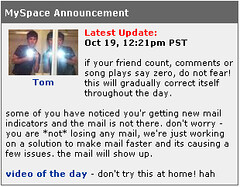
Every day, I login to MySpace to maintain a few different profile pages (professionally, i'm not a weirdo, honest!).
And every day, something's not working properly on MySpace. Often I'm unable to login for a while, clicking a button produces an error page, and those are just the errors affecting me.
Then there's the errors I haven't experienced yet. Because at least once a week, the little 'MySpace Announcement' box is showing an apology from Tom about what's not working right today, with a vague, fuzzy description of what might be wrong, how long it might take to fix, and a glib reassurance.
If Hotmail, Yahoo! Mail or Gmail has a one day outage, the tech community is up in arms, it gets reported as front-page news, and the world as we know it is about to end. Meanwhile, MySpace, the world's biggest online community, staggers from messup to rollback and on to the next set of glitches, and nobody bats an eyelid. "MySpace has always been buggy, what's the problem?" I hear people say.
The problem is, with the sloppy dev culture at MySpace, one day they'll do something dumbass they can't easily recover from. A lot of user data will be lost, a lot of advertisers will want a make-good, and MySpace will acquire a reputation as the last place you'd want to trust with your personal information and social networks. Then, if people start migrating to another online community faster than MySpace's organic growth rate, the MySpace snowball may hit the wall.

A MySpace developer at work.
Thursday, October 19
Rip. Play. Infect?
First McDonalds ships an mp3 player carrying a Windows virus, now some units of Apple's iPod have been infected with a virus loaded on by an OEM doing the manufacture of the little white music machine.
So do we now add our portable music players to the long list of things we have to be wary about plugging into our computers? Unless you're a Mac owner, the answer is yes.
No matter how Apple tries to spin the story into a security issue for Microsoft, it's still Apple's OEM chain that is primarily at fault.
Still, the scariest thing for me is that the virus was included in the pristine, shrink-wrapped, new iPod during manufacture. Something about the psychology of viruses means I never consider brand new hardware as a potential source of viruses. A scuzzy, scarred and nearly-full iPod from one of my many phreaky friends? Sure, I'd think twice about that.
But a brand-new iPod fresh out of the shrinkwrap? That's as close to virginal and pure as a device can be! Handed down from on high! It just doesn't feel right to consider it a home to viruses. Which means all the more risk of bazillions of iPod users on Windows getting mass infections.
I believe the Apple community when it almost universally contends that OS X is virtually impregnable. But it's not my Mac I worry about.
Instead, I worry about what Apple might be forced to do to the iPod and iTunes to protect the bazillions of dumb-ass Windows users out there. Things like hard or soft copy-protection, stupid interruptions along the lines of "are you sure you want to sync your iPod now?" which you'd be forced to accept liability for, and further delays in getting more music labels and more artists selling their music on iTunes Store.
Ick. It all smells of additional cruft to me.





